

Created by skilled artisans, handmade rugs are an excellent asset to any interior. They bring elegance and an arty atmosphere to your home, and will always attract your guests’ attention. While choosing the handmade rug online, you might have come across the different types of products, such as hand knotted vs hand tufted rugs.
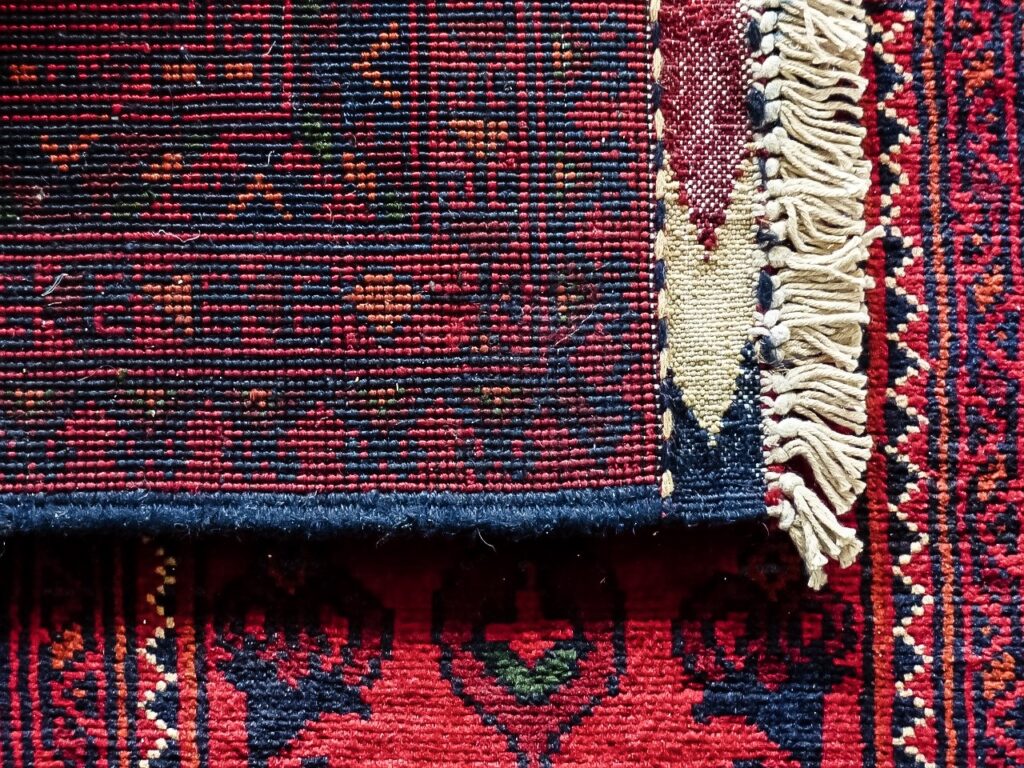
Hand knotting and hand tufting are two completely different and very popular rug creation technologies, which we will explore in detail in our current post.
Hand Knotting Technology
Hand-knotted rugs bring luxury, culture, and elegance to your home.
How to know if the rug is hand-knotted? Hand-knotted rugs consist of thousands of small individual knots invisible to the human eye at the first glance. The yarn is tightly tied around the weft of the rug. These rugs have the highest quality compared to all the handmade rugs and have the longest durability. The smaller is the knot – the more detailed is the pattern.
A professional rug weaver works carefully on every knot and ties every knot individually. This creates complex patterns and designs. In the process, the vertical strings get tied to the weaver, and the weft goes horizontally between the vertical threads, creating the rug foundation. The knots get tied to the thread of warp, and then they get cut and secured.
How Fast Are Hand Knotted Rugs Made?
Did you know that a professional rug knitter can create around 10,000 knots daily? That sounds like a huge number. It would take some crazy skills and really comfortable sewing chairs. Indeed, skilled workers tie the knot every two seconds. Based on this speed, you can count how much time it normally takes to create a hand-knotted rug.
Time varies from 1 month to a few years and depends on the project’s complexity and size. This reflects on the quality and price of the final rug. Hand knotted Persian rugs are the most valuable rug type and become a pricey but a great investment! If you love and care for the rug, it will serve you many decades.
The main determinant of the price of the hand knotted rug is the number of knots per square inch (KPSI). The more knots you have, and the tighter they are, the more pricey is the rug, and the more high-quality it is. The more knots per square inch, the softer the rug is, and the more durable. Other factors that shape the price are the size, complexity of design, and type of fabric. As we said above, when you buy a hand knotted rug, you don’t just pay for the product, you pay for the proficiency and devotion of the artisan rug maker.
Hand Tufting Rug Technology
A hand-tufted rug is a quite popular handmade rug type, and also has better quality compared to machine-made rugs.

The technology behind this process is quite simple compared to knotting and doesn’t require that many years of expertise. To create a rug, a base grid material (usually made of yarn or wool) is placed on the frame. The sketch of the design is then drawn on the base. Using a special tufting gun, the worker then fills the corresponding areas with different colors.
The process looks like the injection of colors into the base. After the surface has been filled, the glued underside is placed on the rug’s backside to fix the fibers. After the edges are secured, the rug is ready for use!
The lifetime of hand tufted rugs depends on the skills of the manufacturer, materials, and maintenance. They can serve up to 20 years.
How to Tell the Difference Between Hand knotted vs Hand tufted rugs?
How to know if the rug is hand-knotted or hand-tufted?
1. Fringe
The look of the fringe is one good method to find if the rug is hand knotted or no. Since the fringe of a hand knotted rug plays a very important role in its construction and is a part of the weaving process, its pieces will be left at the end of the rug. If there wasn’t a fridge, a hand knotted rug would just unravel. When the rug is hand tufted, there won’t a natural fringe. If there is a fringe, it is glued or sewn to the rug. Some sellers do this to make the rug look authentic (to make it look like a hand knotted rug).
2. Backing
If you just went by the fringe look and the design of the rug you would think that this rug was hand-knotted, and unfortunately, that would be incorrect if you found a fabric backing attached to it. It is added after the rug is made to hide the glue that’s holding the rug together. This is a hand tufted machine-made rug. So basically, you should also check the backside of the rug. If you see the glued foundation – that is a hand tufted rug.
If you see the knots and they are somehow uneven, this shows that the rug was created with a human hand. These knots can of an irregular size. Nevertheless, they will last for many decades.
The design of the hand knotted rug looks identical on both sides. Hand knotting is a very detailed process, that’s why you will see a very precise image on the backside, with many small details.
3. Symmetry and Design
Hand knotted rugs will have an absolutely symmetrical image on both sides. Since this rug is created by a crafty artisan, it will be a unique work of art, you won’t find the same piece. You will notice small discrepancies on the backside because this is the handmade process, for example, not all the knots will have the same size.
The hand tufted rug will not have a very precise design, the tufting machine (tufting gun) doesn’t allow to draw very small details and thin lines. Plus, as we said earlier, hand tufted rugs will not have a design on the backside.
4. Texture and Materials
The difference in texture is based on the material and weaving technique. In particular, hand knotted rugs will be much thinner compared to the hand tufted. This is caused by the fact that the hand tufted rug requires an extra-base that is attached (glued) to the structure. Hand knotted rugs are always made of natural materials such as silk or wool. Hand tufted rugs can have different materials combined on the same rug. Artisans often use cheaper artificial fibers for their creation, because it will help to make a more colorful design.
Top 5 Differences Between Hand Knotted and Hand Tufted Rugs
There are many differences between the two rug-making technologies, and we have listed the main ones that will help you make the right choice.
- Price. The cost of hand-knotted rug production is much higher because of the more complex technology. They take a lot more time to produce, and this results in a much higher price. The price of the hand-tufted rugs starts from around $100 to $3,500. The hand-knotted rug price starts from around $1,000 (and the sky is the limit).
- Quality. Hand-knotted rugs are much more durable since each knot is tightly secured by the artisan maker. Hand-knotted rugs can serve you for many decades, while hand-tufted rugs will serve only up to 20 years (in good conditions).
- Design. Because hand-tufted rugs are produced with an automatic machine, and at a faster pace compared to hand-knotted, they don’t have that detailing. Knots allow the hand-knotted rug to have a very precise design, up to the knot. Hand-knotted rugs don’t have that artistic feel.
- Cleaning options. Because of the glue used in the process, and the technology of attaching the fibers to the base, hand-tufted rugs require very delicate cleaning, otherwise the fibers will shred.
- Smell. Unfortunately, the hand tufted rugs often have a rubbery odor, because of the glue and base used in production. They will require some time for the smell to go away. If you have heated floors, this smell may become only worse with time.
Hand-Knotted or Hand-Tufted – What’s the Best Choice for You
While the choice is completely personal, particular differences make a specific rug best for you. Rugs created with a hand knotting technology have more value in a long-term investment. They will last you for many decades or maybe even centuries if you pass them on to the grandchildren. They are not mass produced so every specific rug is a unique piece of art.
The hand tufted rug is not that durable, the fibers will loosen up and shred. It’s a good choice if you like to change rug designs frequently and don’t plan to use the same product for many years.
You should also choose the rug based on your budget. Hand tufted are less pricey and very affordable. It won’t cost you a fortune to choose and replace such a rug based on your room design. On the other side, hand knotted rug is more durable and has a greater lifetime value. You won’t have to replace it anytime soon. Even when it gets old and the color fade away, hand knotted rug can be easily over-dyed and used again.
Choose the rug based on the purpose of use. If you have kids or pets in the house, a hand tufter rug is not the best option. It will shred quicker, and, since it’s not so easy to clean, such rug will become bald very soon. In this case, look for the hand knotted rug with tight knots, that is easier in maintenance.
Conclusion
I hope you enjoyed reading this post and will now easily tell the difference between the hand knotted and hand tufted rugs. Both these rug types have a lot of benefits and disadvantages. To be honest, I love and keep both of them in my home, just use them in different areas. Hand knotted rugs are placed in the high foot traffic areas like the living room, while the hand tufted rugs are where we can all see them but not step on too often. Make the right choice and buy the product based on your needs.