

You won’t get far landscaping your pond without adding some marginal water plants. Marginal plants not only add color and interest to the edge of your pond but are also essential to the health of the aquatic ecosystem. Marginal plants for ponds help filter out toxins, absorb excess nutrients, and prevent significant algae outbreaks. As you can see, marginal plants are essential to maintaining your pond and keeping the ecosystem balanced.
But it can be challenging to find the perfect marginal water plants for your pond. You have to consider color, foliage, climate, and whether the plant will thrive or harm your landscape. You also have to sift through the thousands of options available to you online. Luckily, we’ve compiled a list of seven marginal plants for ponds that are proven to benefit and beautify your aquatic landscape.
Marginal Plants For Ponds – Our Top Picks
Water Irises

If your primary concern is color, then water irises are the perfect marginal water plants for your pond. Water irises come in an array of colors, including shades of white, blue, purple, red, and yellow. So no matter what your favorite color is or how you design your landscape, you are bound to find a water iris that perfectly fits your needs.
Your pond will also benefit from the unique foliage as it looks exquisite, keeps out predators, and shades smaller plants.
However, these beauties not only enhance your pond’s appearance but also improve its health. Water irises are known for removing various toxins from water, so your pond will remain safe for the other plants and wildlife that utilize it.
What’s even better is that multiple species of water irises will thrive as marginal plants for ponds. A few species you should consider include:
- Water Iris (Iris laevigata)
- Blue Flag Iris (Iris versicolor)
- Louisiana Iris (Iris hexagona)
- Southern Blue Flag (Iris virginica)
- Yellow Flag Iris (Iris pseudacorus)
All these species emanate elegance and beautiful color, so they are all great options to consider as marginal water plants.
Calla Lily

The word “calla” comes from the Greek word kallos, which translates to “a thing of beauty.” There is no better way to describe the look and appearance of the globally adored calla lily (Zantedeschia aethiopica). This southern African beauty creates a striking appearance on any pond edge with its enormous trumpet-shaped white flowers accented with a long yellow spadix.
What’s even better is that the calla lily has been known to oxygenate the water, which is good for pond aeration. It is an excellent option if you’re looking to improve the water quality in your pond.
Sedge

No list of marginal plants for ponds would be complete without mentioning sedges. Sedges give a nice grassy appearance to your pond edges and can be utilized well by wildlife. Though there are many great sedges to choose from, one of the best sedges to use as a marginal water plant is the Bowles’ golden sedge (Carex elata).
The Bowles golden sedge offers a stunning golden color that will reflect nicely on the water and light up your landscape. Some varieties have variegated foliage to add further color and interest next to your pond. But if the golden color isn’t your thing, you can find similar species (such as Carex muskingumensis) that come in wonderful shades of blue-gray or green.
Papyrus

A beloved plant since ancient times, papyrus is one of the best marginal water plants to consider if you are looking for something with an exotic or tropical feel. Though once used to make paper, papyrus now is used to stand tall as an appealing feature of pond margins and riversides.
The plant is characterized by tall triangular stems topped by a dense cluster of thin, thread-like rays. It is certainly not a subtle plant, so it will probably stand out as your dominant pond plant. But the appearance is not the only great thing about papyrus. It also has been known to treat wastewater, so it can improve your pond’s water quality. However, you should know that this tropical plant cannot survive freezing temperatures, so you may struggle to keep it alive if you live in a colder climate.
Sweet Flag
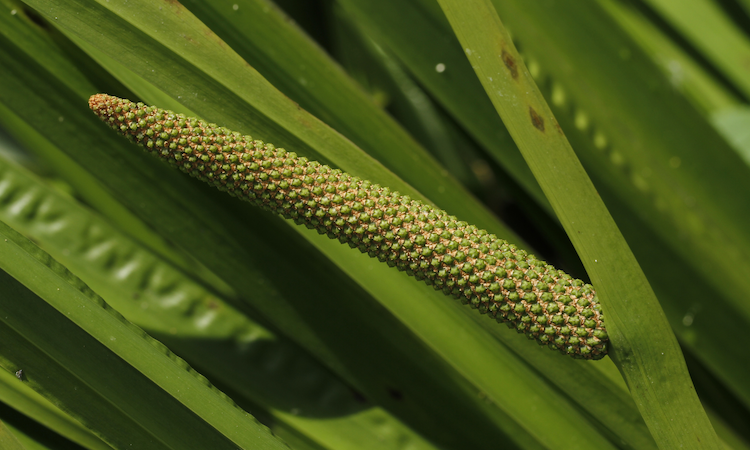
Sweet flag is a perfect addition if you are looking specifically for a foliage marginal water plant. It is often described as having the foliage of water irises but also resembling the appearance of cattails. So if you like both of those plants, you can enjoy them both in the sweet flag.
Aquatic landscapers also love the elegance of the arching sword-shaped leaves. Though every specimen is beautiful, you’ll get more appeal if you go with the variegated variety. The sweet flag also emits a pleasant odor when the leaves are broken, which can add to the atmosphere of your aquatic landscape.
Sweet flag is the name given to multiple species that are all quite similar (Acorus calamus, Acorus americanus, and Acorus gramineus). All of these are excellent marginal plants for ponds and will provide a nice grassy texture to your landscape.
Marsh Marigold

Though not an actual marigold, marsh marigold (Caltha palustris) will dazzle your pond with its exquisite bright yellow blooms. What’s great about the marsh marigold is that it is usually one of the first marginal water plants to bloom in spring, so it will attract the first birds and butterflies of the season.
Marsh marigold is also low maintenance and doesn’t have too many pests, so it brings incredible beauty without asking for much in return.
Marsh marigolds resemble small suns. The marsh marigold is a hardy plant that can tolerate being submerged in water for long periods of time. In fact, the marsh marigold often blooms in early spring before other plants have even begun to grow. The marsh marigold is a beautiful addition to any garden, and it is also a great plant for attracting bees and other pollinators.
This is the perfect feature to add to the sunny edges of your pond, as it will reflect the happy light of the summer sun.
Water Forget-Me-Not

And, of course, let’s not forget water forget-me-not. Water forget-me-not offers a subtle touch of sky blue that adds delicate color to any pond edge. This flower is also low maintenance, so once you plant a few, you don’t need to do much to keep them happy.
Water forget-me-nots are best utilized as a groundcover or flower carpet as they spread quickly. In some regions, this species is invasive, so do some research before planting it in your area.
The plant gets its name from the Greek myth of Demeter and Persephone. In the myth, Demeter is the goddess of agriculture and Persephone is the goddess of spring. When Persephone was abducted by Hades, Demeter was so distraught that she refused to let anything grow.
The only way to get Persephone back was to bring her a small bunch of Water Forget-Me-Nots. Water Forget-Me-Nots are also known as Myosotis Palustris, which means mouse-ear in Latin.
The plant gets this name because the leaves are shaped like mouse ears.
Water Forget-Me-Nots are native to Europe and Asia, but they can now be found all over the world. The plant prefers wet conditions and can often be found growing near ponds and streams.
Water Forget-Me-Nots are annual plants, which means they only live for one growing season. The plant grows to be about six inches tall and has blue flowers with yellow centers. Water Forget-Me-Nots are easy to care for and make an excellent addition to any garden.
Final Thoughts
When looking for marginal plants for ponds, you certainly have more than your pick of options. But the plants mentioned in this article are tried-and-true. Each will provide your landscape with nice color and texture while improving your pond’s health and quality by oxygenating it. By adding any of these marginal plants, your pond will surely be the envy of all your neighbors.